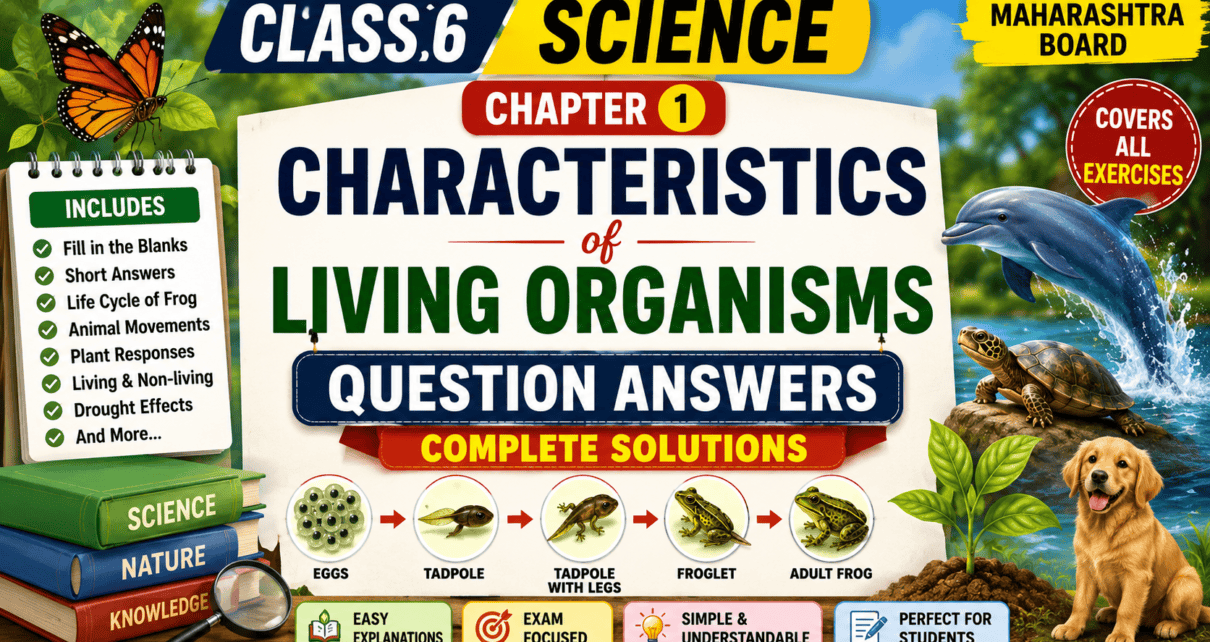
Characteristics of living organisms | Questions & Answers, Class 6 Science Chapter 1 Solutions
Table of Contents
Exercise (1) – Suggest the appropriate word for the blanks.
(a) Every living organism produces another living organism like itself is called ________.
Answer: Reproduction
(b) ________ and ________ are the main characteristics of living organisms.
Answer: Growth and Reproduction
(c) The growth and development of living organisms due to food is called the ________ of living organisms.
Answer: Nutrition
(d) The body of living organism is made up of ________.
Answer: Cells
Exercise (2)
Question: Birds, fish and animals can move and change their position on their own. Shed leaves, as well as vehicles like tractors and bullock carts can also change their position. What are the important differences between these two types of movements?
Answer:
- Birds, fish and animals move on their own because they are living organisms.
- They move using their body parts and muscles.
- Shed leaves and vehicles cannot move on their own.
- They need external forces such as wind, people or machines to move.
- Therefore, movement in living things is self-driven, while movement in non-living things depends on external force.
Exercise (3)
Question: Germs of many diseases are extremely microscopic. They are so small that they cannot be seen with the naked eye. Do such living organisms reproduce? Explain how you decided this.
Answer: Yes, microscopic germs reproduce. Their number increases rapidly and diseases spread from one person to another. This proves that they reproduce just like other living organisms.
Exercise (4)
Question: Explain that animals like rats, cats and dogs show awareness of their surroundings through their behaviour. Write down your experiences about it and observations of how they behave in different situations.
Answer:
- A dog barks when strangers come near the house.
- A cat runs after mice when it sees them.
- Rats hide quickly when they hear sounds or see people.
- Dogs wag their tails when they see their owners.
- These behaviours show that animals respond to their surroundings.
Exercise (5)
Question: Make a list of different types of animal movements along with the animals that move in those ways.
Answer:
| Type of movement | Animals |
|---|---|
| Walking | Cow, Dog, Cat |
| Running | Horse, Deer, Cheetah |
| Flying | Sparrow, Eagle, Pigeon |
| Swimming | Fish, Whale, Dolphin |
| Crawling | Snake, Earthworm |
| Hopping | Frog, Kangaroo |
| Climbing | Monkey, Squirrel |
Exercise (6)
Question: Plants respond to stimuli. Write down as many observations and experiences as you can which demonstrate this.
Answer:
- Sunflower turns towards sunlight.
- Touch-me-not (Mimosa) closes its leaves when touched.
- Plant roots grow towards water.
- Shoots grow upwards towards light.
- Some flowers bloom during the day and close at night.
- Climbers coil around support.
Characteristics of living organisms | Questions & Answers, Class 6 Science Chapter 1 Solutions
Exercise (7)
Question: Turtles stay in water for a long time. Why do they come to the surface repeatedly and poke their heads out of the water? Fish, however, do not try this. Why?
Answer: Turtles breathe through lungs, so they must come to the surface to take in air. Fish breathe through gills, which take oxygen from water, so they do not need to come to the surface to breathe.
Exercise (8)
Question: The life cycle of a frog is given below in a jumbled order. Give the correct number in the boxes to put them in the proper sequence.
Answer (Correct Sequence):
- Eggs
- Tadpole with legs
- Tadpole
- Froglet (young frog with tail)
- Adult Frog
Numbering for the pictures from left to right:
- Tadpoles → 3
- Adult Frog → 5
- Eggs → 1
- Tadpole with legs → 2
- Froglet → 4
Exercise (9)
Question: Classify the following into living and non-living groups based on their characteristics.
(Stone, butterfly, bicycle, book, fish, air, tree, kite, bus)
Answer:
Living Things
- Butterfly
- Fish
- Tree
Non-living Things
- Stone
- Bicycle
- Book
- Air
- Kite
- Bus
Exercise (10)
Characteristics of living organisms | Questions & Answers, Class 6 Science Chapter 1 Solutions
(A) Question: What are the effects on the animals when there is a drought and there is no food or water available for them?
Answer:
- Animals become weak and sick.
- They suffer from hunger and thirst.
- Many animals migrate in search of food and water.
- Some animals die due to lack of food and water.
(B) Question: A tiger cub grows; does it also develop? Explain this statement.
Answer: Yes. A tiger cub not only grows in size but also develops. As it grows, it learns to walk, run, hunt, protect itself and survive independently. These changes are called development.
Project
Question: :Talk to the elders and collect information from them about where and how natural gum is obtained and what other substances are obtained in the similar way.
Answer:
Natural gum is obtained from trees such as Acacia (Babool) by making small cuts in the bark. A sticky liquid oozes out, hardens on exposure to air and is collected as gum.
Other substances obtained in a similar way include:
- Latex (used to make rubber)
- Resin (from pine trees)
- Gum Arabic
- Frankincense
- Myrrh
These substances are collected by making cuts in the bark of specific trees.
Characteristics of living organisms | Questions & Answers, Class 6 Science Chapter 1 Solutions
Makar Sankranti Essay – in Marathi- Click here.
Essay Topics List in Marathi, Hindi, and English:
English Essay
Question Answer for All Standard
मराठी निबंध
हिंदी निबंध
Other Essays:
➥ Essay on My School in English
➦ मेरा विद्यालय पर निबंध
➥ Essay on my favorite festival in Marathi – Ganapati
➦ Essay on tree in Marathi
➥ माझी शाळा निबंध मराठी
➦ My Favourite Animal Essay In Marathi (Dog)
➥ जर मी ढग असतो तर :
इतर लिंक्स :
➥ मराठी रंग :
➦ विशेषण व विशेषणाचे प्रकार
➥ सर्वनामाचे प्रकार
➦ Modal Auxiliary
➥ Types of Figure of speech